
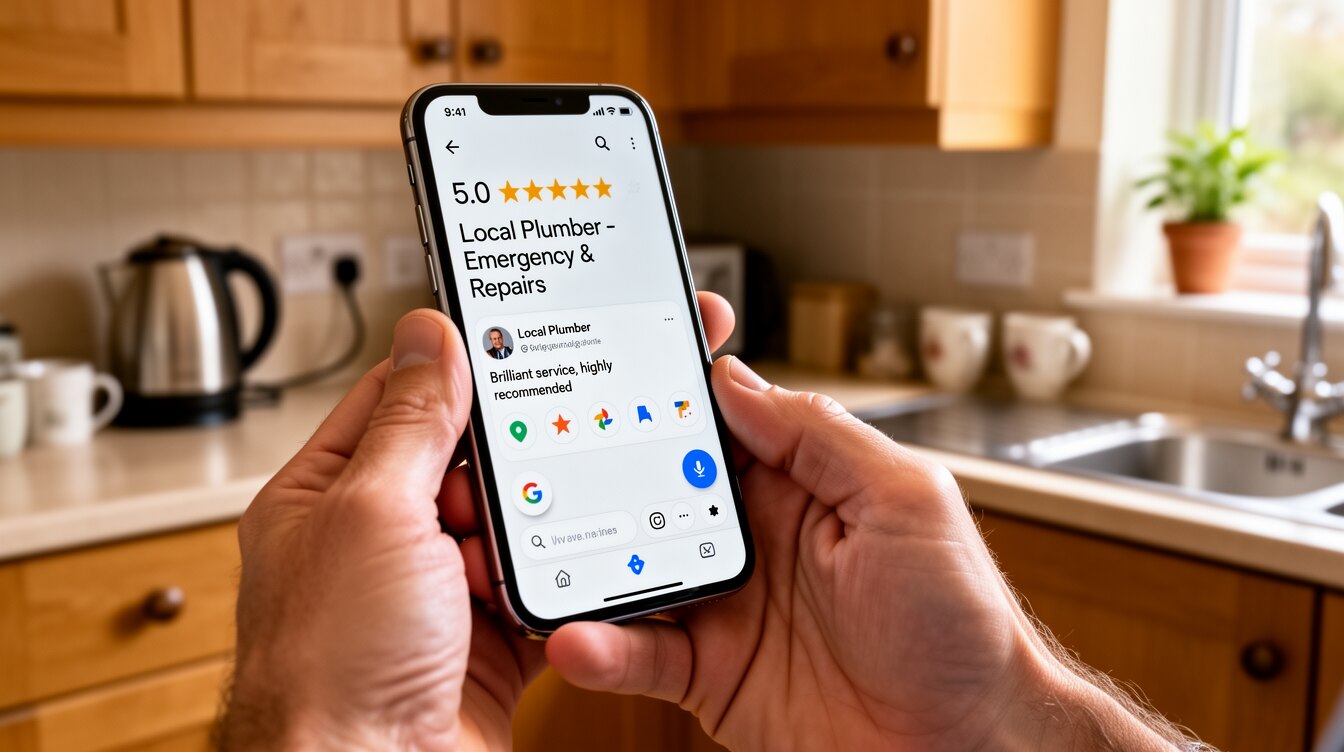
Homeowners check reviews before they call. The trades that win the work are the ones with a visible, recent stack of them. Our audit found that most tradesmen are badly short, and that the gap is one of the easiest advantages in local marketing to seize.
Here is what we found across 4,895 trade businesses, why a high star rating can be misleading, and why this gap is an open goal.
How we did this
Sample: 4,895 UK trade businesses across 61 towns and 25 trades, concentrated in Hertfordshire and the surrounding South East of England. Collected: 2026, from public Google Business Profiles and business websites. All percentages from our own data are of the businesses we analysed, not a national census. Because every business was found via Google in the first place, our figures most likely understate the true gaps. External figures are cited and linked inline.
The key findings
- 48% of the trade businesses we analysed have fewer than 10 Google reviews, and 69% have fewer than 25.
- 11% have no Google reviews at all. Their listing is effectively a blank.
- The median across all 4,895 businesses is just 10 reviews. The mean is dragged up to around 33 by a small number of well-reviewed firms.
- Only about 17% have 50 or more reviews, the level that genuinely reassures a cautious homeowner.
- A high star rating is not the flex it looks like: with so few reviews, a single five-star rating produces a perfect average, so volume matters more than the score.
Reviews are the deciding factor, and tradesmen are short of them
Before a homeowner lets anyone near their house, they look you up and read what other people said. BrightLocal research finds that the vast majority of consumers read reviews when researching a local business, only around 4% never do, and 74% check two or more review sites before deciding.
Against that, a trade business with a handful of reviews, or none, is asking the customer to take a leap of faith that the firm down the road is not. Most people simply will not. They quietly pick whoever looks the most proven.
Why a perfect rating can work against you
Plenty of tradesmen point to a 5.0 average as proof they are the best in town. The problem is the maths. When a business has only three or four reviews, one happy customer produces a flawless score, and a savvy homeowner knows it.
Volume is what carries weight. Twenty honest reviews averaging 4.7 reassures far more than three at 5.0, because it shows a track record rather than a lucky start. The businesses in our sample with real review counts are the exception, not the rule.
Reviews are also local SEO, not just reassurance
Reviews do double duty. As well as convincing the customer, the number, quality and freshness of your Google reviews are among the strongest factors deciding whether you appear in the local map pack, where a large share of local trade enquiries begin.
A steady trickle of recent reviews lifts you in those results. A dormant listing with five reviews from two years ago sinks. Most tradesmen, our data suggests, are in the second group.
The gap is one of the easiest wins in local marketing
Here is the encouraging part. BrightLocal also finds the overwhelming majority of consumers are willing to leave a review when asked. The reason most tradesmen have so few is simply that they never ask.
Make asking part of finishing a job. A short link texted to the customer the day after turns a good job into a review, and reviews into more work. Pair it with a tidy Google Business Profile and you move ahead of most of your local market for the price of a few text messages.
Frequently asked questions
How many Google reviews does the average tradesman have?
Do Google reviews affect local search rankings?
How can a tradesman get more reviews?
Is a 5-star rating with few reviews good?
Want to look like the obvious choice?
We build websites for tradesmen that show your reviews properly and make it easy for customers to leave more, alongside the Google Business Profile setup that makes them count. From £750, and you own everything. Based in Watford.